
Agricultural Land in Net Worth Certificate
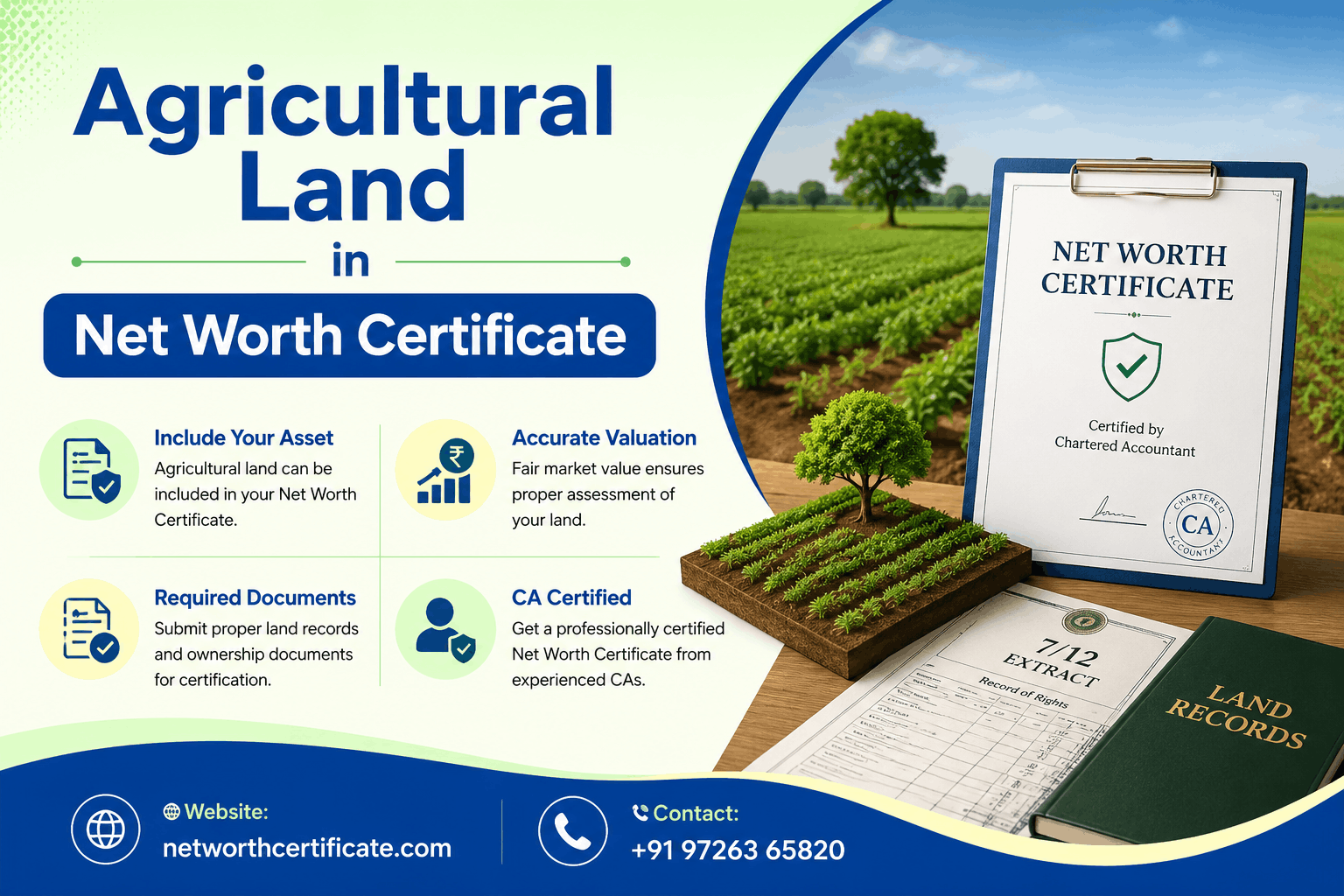
Welcome to our blog! Today, we will discuss Agricultural Land in Net Worth Certificate. Understand how this valuable asset can be included while calculating an individual’s overall net worth. Agricultural land is a significant asset owned by many individuals and families in India and may contribute substantially to their financial position. In general, agricultural land can be included in a Net Worth Certificate when the ownership is properly established through valid legal and revenue records and the property is valued on a reasonable and acceptable basis. A Net Worth Certificate provides a clear statement of a person’s total assets and liabilities as on a particular date, and agricultural land may be included as part of the asset base after considering factors such as ownership rights, land records, valuation method, joint ownership, inherited or ancestral property, and outstanding loans.
Can Agricultural Land Be Included in a Net Worth Certificate?
Yes, agricultural land can generally be included as an asset in a Net Worth Certificate if the individual has legally supportable ownership or a recognised beneficial interest in the property. The land should be properly identifiable through valid ownership and revenue records. Depending on the state and local land-record system, documents such as a registered sale deed, Record of Rights (RoR), 7/12 extract, 8-A extract, mutation entry, property card, or other equivalent land records may be used to support ownership. Since documentation requirements can vary from one state to another, a Chartered Accountant generally reviews the available property documents and determines the appropriate basis for including the agricultural land in the net worth statement.
Agricultural Land in Net Worth Certificate can be an important part of an individual’s overall financial position, particularly when the property is legally owned and supported by proper documentation. However, including agricultural land in a Net Worth Certificate does not mean that the property can be reported at any value. The ownership status, supporting documents, valuation basis, ownership share, and any outstanding loan or liability connected with the property should be properly considered before determining its value for the purpose of the certificate. The final reporting should provide a reasonable and supportable representation of the individual’s net worth as on the relevant date.
Why Should Agricultural Land Be Included in a Net Worth Certificate?
Agricultural land can be a valuable part of an individual’s overall wealth and may represent a significant portion of the person’s total assets. If a person owns substantial agricultural land but it is not considered while preparing the Net Worth Certificate, the certificate may not present a complete picture of their financial position. Including eligible agricultural land helps provide a more comprehensive and transparent view of the individual’s total assets, provided that the ownership is properly established and supported by reliable property and revenue records.
A person’s overall net worth may include various types of assets, such as:
Agricultural land
Residential property
Commercial property
Bank balances
Investments
Shares and securities
Vehicles
Business interests
Other financial and physical assets
The value of agricultural land included in a Net Worth Certificate should be based on a reasonable and supportable valuation basis. The valuation date is also important because land prices may change over time due to location, market conditions, development, infrastructure, and other factors. Depending on the purpose of the certificate, the Chartered Accountant may review the available documents and valuation information before considering the appropriate value of the property.
For professional valuation assignments, the ICAI Valuation Standards, 2018 provide guidance on important aspects such as valuation bases, valuation approaches, analysis, documentation, and reporting. For valuation engagements conducted under laws other than the Companies Act, these standards are generally recommendatory for Chartered Accountants. Therefore, proper documentation and a clear valuation basis can help ensure that agricultural land is appropriately reflected in the Net Worth Certificate.
How Is Agricultural Land Valued in a Net Worth Certificate?
The value of Agricultural Land in Net Worth Certificate is generally determined by considering the property’s location, size, ownership details, legal records, market conditions, and the purpose for which the certificate is being prepared. Since the value of agricultural land can vary significantly from one location to another, the valuation should be based on relevant and supportable information rather than an arbitrary estimate.
Key Factors Considered in Agricultural Land Valuation
When assessing the value of agricultural land, the following factors may be considered:
| Valuation Factor | Why It Matters |
|---|---|
| Location | Land in a developed or strategically located area may have higher value. |
| Total Area | The size of the agricultural land directly affects its overall value. |
| Road Connectivity | Easy access and road connectivity can influence market value. |
| Nearby Development | Infrastructure, residential projects, highways, and other developments may affect land prices. |
| Comparable Transactions | Recent sale transactions of similar land can provide useful market evidence. |
| Local Market Conditions | Demand and prevailing land prices in the area may influence valuation. |
| Government or Guideline Value | Applicable government records or guideline values may be considered where relevant. |
| Nature and Classification of Land | The classification and permitted use of the land may affect its value. |
| Transfer or Usage Restrictions | Legal restrictions on ownership, transfer, or use may impact valuation. |
| Encumbrances and Liabilities | Mortgages, charges, disputes, or other liabilities may affect the net value. |
Valuation Date Is Important
Agricultural land should generally be valued with reference to a specific valuation date. For example, the value of agricultural land as on 31 March 2026 may be different from its value on another date because market conditions, infrastructure development, demand, and other factors can change over time.
Depending on the purpose of the Net Worth Certificate, the valuation may be supported by relevant property documents, market evidence, comparable sale information, professional valuation reports, or other appropriate records. The final approach may vary based on the nature of the property and the requirements of the bank, government authority, educational institution, immigration authority, or other organisation receiving the certificate. This helps ensure that the value of agricultural land reported in the Net Worth Certificate is reasonable, transparent, and supported by appropriate documentation.
Documents Required to Include Agricultural Land in a Net Worth Certificate
To include agricultural land in a Net Worth Certificate, the property owner should provide documents that establish ownership, verify land details, and support the property’s value. The exact documents may vary depending on the state, the nature of ownership, and the purpose of the certificate. However, submitting complete and accurate records helps the Chartered Accountant verify the asset and prepare a reliable net worth certificate.
The following documents are commonly required:
- Registered Sale Deed or other valid ownership document
- Record of Rights (RoR) or equivalent land record
- 7/12 Extract (Satbara Utara), where applicable
- 8-A Extract, where applicable
- Mutation Entry (Ferfar Entry) showing the latest ownership details
- Property Card, if applicable
- Survey Number or Land Identification Details
- Latest Land Revenue Receipt or Property Tax Receipt
- Inheritance or Succession Documents, if the land is inherited
- Gift Deed or Partition Deed, where applicable
- Loan or Mortgage Documents, if the land is financed
- Valuation Report, if required for the specific purpose of the net worth certificate
- Identity Proof of the Owner to match ownership records
Before issuing the certificate, a Chartered Accountant reviews these documents to verify ownership, identify any joint ownership or liabilities, and determine the appropriate value of the agricultural land. Providing complete and up-to-date documents helps avoid delays and ensures that the agricultural land is accurately reflected in the net worth certificate.
How to Include Agricultural Land in a Net Worth Certificate?
Including agricultural land in a Net Worth Certificate involves more than simply declaring its value. The property should be supported by valid ownership documents, appropriate land records, and a reasonable valuation. Following the correct process helps ensure that the certificate accurately reflects your financial position and meets the requirements of banks, visa authorities, financial institutions, or other organizations.
- Step 1: Gather Ownership Documents
Collect all documents that establish your ownership of the agricultural land, such as the registered sale deed, Record of Rights (RoR), 7/12 extract, mutation entry, property card, or other applicable land records.
- Step 2: Verify Land Records
Ensure that the land records are updated and that the owner’s name, survey number, land area, and other details are consistent across all documents. Any discrepancies should be corrected before preparing the net worth certificate.
- Step 3: Determine the Ownership Share
If the agricultural land is jointly owned, inherited, or ancestral, calculate only your legal ownership share. The entire value of the property should not be included unless you are the sole owner.
- Step 4: Determine the Fair Market Value
Estimate the current value of the agricultural land by considering factors such as location, land size, nearby developments, market trends, comparable sales, and government guideline values where applicable. A professional valuation report may be required in certain cases.
- Step 5: Consider Outstanding Loans or Liabilities
If the agricultural land is mortgaged or financed through a loan, disclose the outstanding liability. The net worth calculation should consider both the asset value and the related liability.
- Step 6: Submit Documents to the Chartered Accountant
Provide all ownership records, valuation details, and liability documents to the Chartered Accountant. The CA will review the information, verify the supporting documents, and prepare the net worth statement accordingly.
- Step 7: Issue the Net Worth Certificate
After verification, the Chartered Accountant prepares and issues the Net Worth Certificate, showing the value of the agricultural land along with your other assets and liabilities as of the specified date.
Can Jointly Owned, Inherited, or Ancestral Agricultural Land Be Included?
jointly owned, inherited, or ancestral agricultural land may be included in a net worth certificate, subject to appropriate evidence of the person’s ownership or share in the property.
However, the entire value of the land should not automatically be reported as the net worth of one person if the land is jointly owned.
For example, if a person owns a 25% share in agricultural land, the value considered for that person may generally be based on the person’s ownership interest, subject to the valuation basis and the specific requirements of the certificate.
For inherited or ancestral property, the ownership position should be supported by appropriate documents, which may include:
- Succession documents
- Will or probate documents, where applicable
- Legal heir or succession records
- Family settlement documents
- Mutation entries
- Partition deeds
- Court orders, where applicable
- Updated revenue records
The exact documents depend on how the property was acquired and whether the ownership has been legally recorded.
How to Calculate Your Share in Jointly Owned Agricultural Land?
When agricultural land is jointly owned by multiple individuals, only the owner’s actual share in the property should generally be considered while preparing a net worth certificate. The ownership percentage should be verified through reliable documents such as the sale deed, partition deed, family settlement agreement, mutation records, Record of Rights, or other relevant land records. This helps ensure that the value reported in the net worth statement accurately reflects the individual’s ownership interest.
Example of Ownership Share Calculation
Suppose the total market value of jointly owned agricultural land is ₹1 crore and a person owns a 50% share in the property.
Calculation:
₹1 crore × 50% = ₹50 lakh
Therefore, ₹50 lakh may represent the value of that person’s ownership share, subject to the applicable valuation method, supporting documents, ownership conditions, and the purpose of the Net Worth Certificate.
The actual value considered may vary depending on factors such as the valuation approach, restrictions on the sale or transfer of the land, legal ownership terms, and any liabilities or encumbrances connected with the property. A common mistake is to report the full value of jointly owned agricultural land as the asset of only one co-owner. Therefore, the ownership share should be carefully verified before including the land in the Net Worth Certificate. If the ownership percentage is unclear, disputed, or not properly supported by documents, additional legal or documentary clarification may be required.
Market Value or Jantri Value: Which One Should Be Used?
When Agricultural Land in Net Worth Certificate, one important question is whether the property should be reported at its market value or government value, such as the Jantri value, circle rate, or other applicable guideline value. These two values may not always be the same, and the appropriate valuation basis can depend on the purpose of the certificate and the requirements of the organisation receiving it.
Market value generally represents the estimated price that the agricultural land may reasonably fetch in an open market under relevant market conditions. On the other hand, the government or guideline value is determined or published by the relevant government authority and may be used for specific administrative, registration, stamp duty, or taxation-related purposes. Depending on the circumstances, a Chartered Accountant may review available valuation evidence, property records, market conditions, and the requirements of the certificate before determining the appropriate basis for reporting the land.
The value reported in a Net Worth Certificate should be reasonable, supportable, and consistent with the available documents. Landowners should avoid using an artificially inflated value simply to show a higher net worth. A proper valuation should be supported by relevant evidence and applied consistently. Professional valuation practices also emphasise important principles such as transparency, appropriate valuation approaches, analysis, documentation, and clear reporting when determining the value of assets such as agricultural land.
Common Mistakes to Avoid When Including Agricultural Land
The Agricultural land can be an important asset in a Net Worth Certificate, but incorrect information or incomplete documentation can create difficulties during verification. Before including agricultural land, it is important to check the ownership details, property records, valuation basis, and any liabilities connected with the land.
- Reporting the Full Value of Jointly Owned Land
Only the individual’s actual ownership share should generally be considered, not the entire value of the property. - Using an Unsupported Property Value
The reported value should have a reasonable and supportable basis. An unrealistic or inflated value may create verification issues. - Using Outdated Land Records
Old revenue records or ownership documents may not accurately reflect the current ownership status. - Ignoring Loans or Mortgages
Any outstanding loan, mortgage, charge, or other liability connected with the agricultural land should be properly considered. - Not Updating Mutation Records
If ownership has changed through sale, inheritance, partition, or another transfer, the mutation records should be updated wherever applicable. - Providing Inconsistent Property Details
Differences in the owner’s name, survey number, land area, or other details across documents may require clarification. - Including Disputed Property Without Clarification
Legal disputes or unclear ownership rights should be properly disclosed and reviewed before including the property. - Confusing Market Value with Government Value
Jantri value, circle rate, guideline value, and market value may be different. The appropriate valuation basis should be determined according to the purpose of the certificate. - Not Providing Inheritance or Succession Proof
Property received through inheritance should be supported by relevant succession, legal heir, will, or other applicable documents. - Submitting Incomplete Ownership Documents
Missing title documents or incomplete records can make it difficult to verify the ownership and value of the agricultural land. - Relying Only on Self-Declared Value
A self-declared property value without supporting documents or valuation evidence may not be sufficient for proper verification.
Your Trusted Partner for Agricultural Land in Net Worth Certificate
We are committed to providing reliable and professional Net Worth Certificate services for individuals, NRIs, business owners, and professionals across India. Whether you need to include agricultural land for a visa application, bank loan, immigration, investment, or financial verification, our experienced Chartered Accountants ensure accurate asset valuation, proper document verification, and a hassle-free certification process. We focus on timely service, transparency, and compliance, helping you obtain a Net Worth Certificate that meets your specific requirements with confidence.
