
NRIs Include Foreign Assets in a Net Worth Certificate?
Welcome to our blog! If you’re wondering, NRIs Include Foreign Assets in a Net Worth Certificate? you’re in the right place. In this guide, we’ll explain everything you need to know in a simple and practical way. Many Non-Resident Indians (NRIs) own valuable assets outside India, such as overseas bank accounts, residential and commercial properties, stocks, mutual funds, retirement funds, and business investments. Including these foreign assets in a net worth certificate helps present a complete and accurate picture of your financial position for purposes such as visa and immigration applications, overseas education, bank loans, investment planning, business transactions, and financial verification. We’ll also cover which foreign assets can be included, the documents required, how Chartered Accountants (CAs) value overseas assets and the key compliance points every NRI should know before obtaining a Net Worth Certificate.
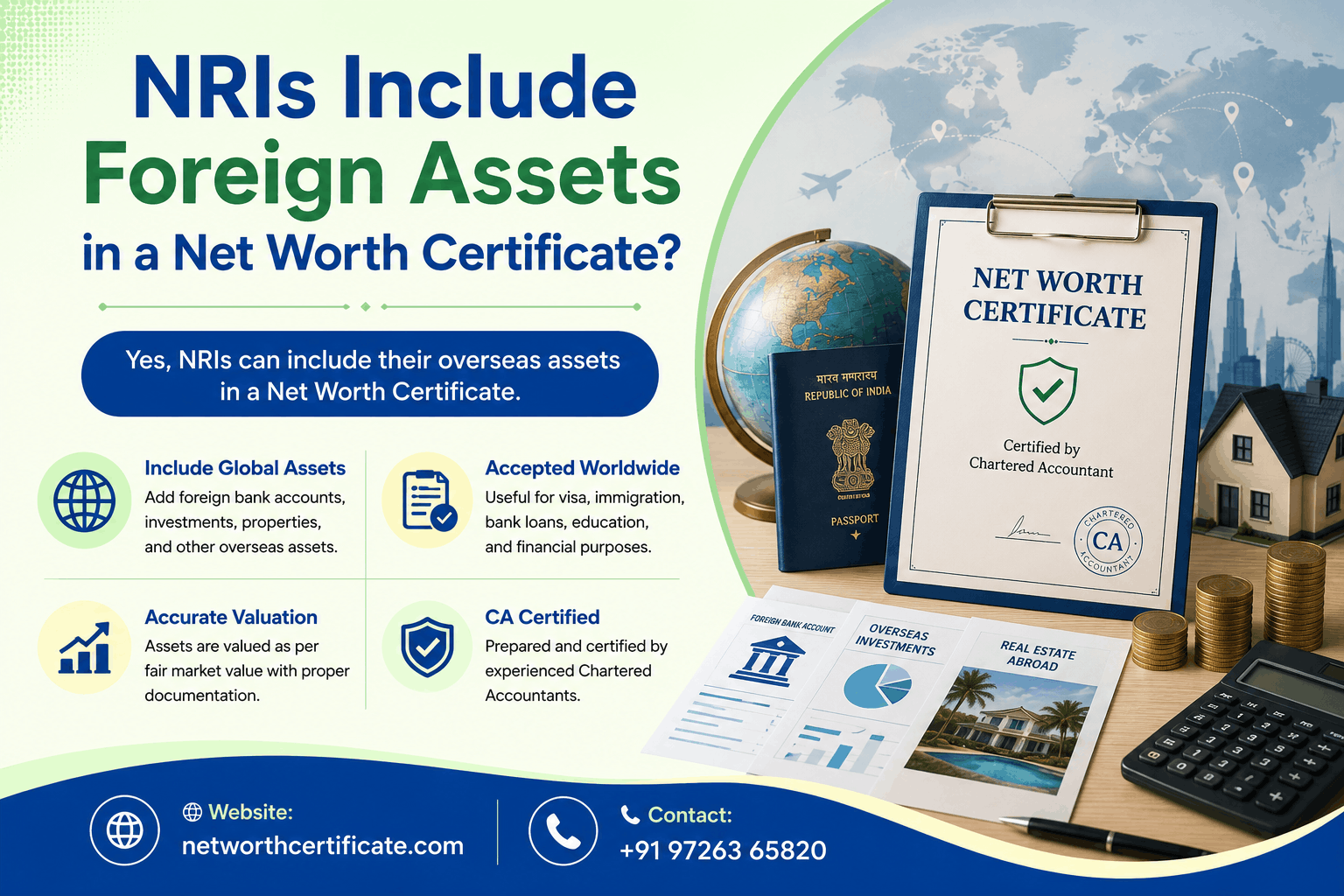
What Foreign Assets Can NRIs Include in a Net Worth Certificate?
Foreign assets are any movable or immovable assets owned by an NRI outside India. Since many NRIs build a significant portion of their wealth abroad, these assets can be included in a Net Worth Certificate, provided ownership can be verified and their value is supported by appropriate documents. Including foreign assets gives a Chartered Accountant (CA) a complete view of your financial position instead of considering only assets located in India.
Some of the most commonly included foreign assets are:
- Overseas savings and current bank accounts
- Fixed deposits (FDs) maintained with foreign banks
- Residential and commercial properties located outside India
- Shares listed on international stock exchanges
- Mutual funds and Exchange-Traded Funds (ETFs)
- Government bonds and corporate securities
- Retirement, pension, and superannuation accounts
- Business ownership, partnership, or company shares
- Gold, silver, and other precious metals held overseas
- Cryptocurrency investments, where ownership and valuation can be properly documented
- Other financial investments, such as insurance-linked investment products, foreign investment portfolios, and wealth management accounts
Including these foreign assets helps prepare a more accurate and comprehensive Net Worth Certificate, which is often required for visa and immigration applications, bank loans, overseas education, business investments, financial planning, and wealth verification. However, every asset should be supported by valid ownership documents and a reasonable valuation to ensure the certificate is transparent, reliable, and professionally certified by a Chartered Accountant.
What Types of Foreign Assets Can NRIs Include in a Net Worth Certificate?
A NRIs Include Foreign Assets in a Net Worth Certificate is intended to reflect your total financial strength, not just the assets you own in India. Therefore, NRIs can include a wide range of foreign assets and overseas bank accounts, provided they legally own them and can submit the necessary documents to verify ownership and value.
Whether your wealth is held in bank deposits, real estate, investments, or business interests abroad, these assets can generally be considered while preparing a Net Worth Certificate by a Chartered Accountant (CA).
✅ Overseas savings and current bank accounts
✅ Fixed deposits (FDs) maintained with foreign banks
✅ Residential properties located outside India
✅ Commercial properties held overseas
✅ Shares listed on international stock exchanges
✅ Mutual funds and Exchange-Traded Funds (ETFs)
✅ Government and corporate bonds
✅ Retirement accounts (401(k), Superannuation, etc.)
✅ Pension funds
✅ Business ownership, company shares, or partnership interests
✅ Gold, silver, and other precious metals (with valuation proof)
✅ Cryptocurrency investments (supported by ownership and valuation documents)
✅ Other overseas financial investments and wealth management portfolios
Important: Every foreign asset should be backed by valid supporting documents, such as bank statements, investment statements, property ownership records, valuation reports, or business ownership documents. A Chartered Accountant will verify these documents before including the assets in the Net Worth Certificate.
Benefits of Including Foreign Assets in a Net Worth Certificate
For many NRIs, a significant portion of their wealth is built and maintained outside India. If these overseas assets are not included, the Net Worth Certificate may show only a part of their financial position, resulting in an incomplete picture of their actual wealth. Including eligible foreign assets helps ensure that the certificate accurately reflects your total net worth and provides greater financial transparency.
A Chartered Accountant (CA) considers both Indian and foreign assets, along with any outstanding liabilities, to prepare a comprehensive Net Worth Certificate that can be confidently used for financial and official purposes.
✔ Shows Your Complete Financial Position
Including overseas assets ensures your Net Worth Certificate reflects your total wealth instead of only your assets located in India.
✔ Strengthens Visa and Immigration Applications
Many countries require proof of financial stability. A comprehensive Net Worth Certificate can support applications for visas, permanent residency, or citizenship.
✔ Supports Overseas Education
Students applying to foreign universities may need to demonstrate their family’s financial capacity for tuition fees and living expenses.
✔ Improves Bank Loan and Financial Approval Chances
Banks and financial institutions often evaluate an applicant’s overall financial strength before approving loans or other credit facilities.
✔ Helps with Investment and Business Opportunities
Investors, business partners, and financial institutions may request a Net Worth Certificate to assess financial credibility before entering into transactions.
✔ Simplifies Financial Verification and Due Diligence
A complete record of global assets makes it easier to meet financial verification requirements during audits, investments, or business transactions.
✔ Assists in Estate and Wealth Planning
Including foreign assets helps in succession planning, inheritance planning, and overall wealth management by providing a clear picture of your global assets.
How Are Foreign Assets Valued in a Net Worth Certificate for NRIs?
Valuing foreign assets accurately is an important part of preparing a NRIs Include Foreign Assets in a Net Worth Certificate. Since overseas assets may include different types of investments, properties, and financial holdings, each asset is valued using an appropriate and reliable method based on its nature and available supporting documents.
A Chartered Accountant (CA) evaluates foreign assets using reasonable, verifiable, and accepted valuation methods to ensure that the Net Worth Certificate reflects the actual financial position of the individual.
🏦 Overseas Bank Accounts
Foreign savings accounts, current accounts, and fixed deposits are generally valued based on the closing balance mentioned in the latest official bank statement or account confirmation provided by the financial institution.
🏠 Foreign Residential and Commercial Properties
Properties located outside India are valued based on their current market value, supported by valuation reports, property documents, or reliable market comparisons.
📈 International Shares and Stocks
Listed shares and securities are valued using the market price available on the valuation date, usually based on recognized stock exchanges.
📊 Mutual Funds and ETFs
Foreign mutual funds and Exchange-Traded Funds (ETFs) are valued according to their latest Net Asset Value (NAV) or market value as on the specified valuation date.
🏢 Private Business Ownership
Ownership interests in foreign companies or partnerships may be valued based on financial statements, ownership percentage, business performance, or accepted business valuation methods.
💰 Retirement and Pension Accounts
Foreign retirement plans, pension funds, and similar accounts are valued using the latest available account statement or balance confirmation issued by the financial institution.
🪙 Gold and Precious Metals
Overseas gold, silver, and other precious metals are valued based on the prevailing market price on the valuation date, along with available ownership proof.
₿ Cryptocurrency Investments
Cryptocurrency holdings may be considered based on their market value on the valuation date, supported by transaction records, wallet details, and exchange statements.
Documents Needed for Foreign Asset Verification
To include foreign assets in a Net Worth Certificate, NRIs need to provide documents that establish ownership, existence, and value of overseas assets. The required documents may vary depending on the type of asset, but the following are the most commonly required documents:
- ✅ Passport Copy – For NRI identity verification
- ✅ PAN Card (if applicable) – For financial identification in India
- ✅ Latest Overseas Bank Statements – For foreign savings accounts, current accounts, and deposits
- ✅ Fixed Deposit Certificates – For foreign bank fixed deposits
- ✅ Foreign Property Ownership Documents – For residential or commercial properties abroad
- ✅ Property Valuation Report – To determine the current market value of overseas property
- ✅ Investment Statements – For foreign shares, mutual funds, ETFs, bonds, and securities
- ✅ Retirement or Pension Account Statements – For overseas retirement funds
- ✅ Business Ownership Documents – For foreign companies, partnerships, or business interests
- ✅ Foreign Loan or Liability Statements – For outstanding mortgages or loans related to foreign assets
Providing these documents helps the Chartered Accountant (CA) verify ownership and valuation of foreign assets and prepare an accurate and reliable Net Worth Certificate for official purposes such as visa applications, immigration, loans, investments, and financial verification.
How to Get a Net Worth Certificate with Foreign Assets ?
Obtaining a Net Worth Certificate that includes foreign assets is a straightforward process when all the required documents are available. A Chartered Accountant (CA) verifies your overseas assets, liabilities, and supporting documents before preparing and certifying the certificate.
- Step 1: Gather Your Documents
Collect all relevant documents, including identity proof, overseas bank statements, property documents, investment statements, and details of any foreign liabilities.
- Step 2: Share Your Financial Information
Provide complete details of your foreign assets, overseas bank accounts, investments, properties, business interests, and outstanding loans or liabilities to the Chartered Accountant.
- Step 3: Asset Verification and Valuation
The Chartered Accountant verifies the ownership documents, reviews the supporting records, and values each foreign asset using appropriate valuation methods.
- Step 4: Currency Conversion and Net Worth Calculation
All foreign assets and liabilities are converted into Indian Rupees (INR) using the applicable exchange rate. The CA then calculates your total assets, deducts outstanding liabilities, and determines your net worth.
- Step 5: Issue of the Net Worth Certificate
After completing the verification and valuation process, the Chartered Accountant prepares and certifies the Net Worth Certificate, which can be used for visa applications, immigration, bank loans, overseas education, investment purposes, and other financial or legal requirements.
How Are Foreign Assets Converted into INR for a Net Worth Certificate?
- Foreign assets held in currencies such as USD, GBP, EUR, CAD, AUD, or other foreign currencies are converted into Indian Rupees (INR) for preparing the Net Worth Certificate.
- The valuation date is finalized first, and all foreign asset values are considered as of that specific date.
- The applicable foreign exchange rate on the valuation date or an accepted reference date is used for converting foreign currency values into INR.
- Overseas bank balances are converted based on the foreign currency amount available in the latest bank statement.
- Foreign properties are converted into INR after determining their value in the local currency and applying the relevant exchange rate.
- Foreign shares, mutual funds, ETFs, and securities are valued in their respective currencies and then converted into INR.
- Retirement accounts and pension funds held abroad are converted based on the available account balance and applicable currency exchange rate.
- The same exchange rate methodology should be applied consistently to avoid differences in valuation among various assets.
- The source of the exchange rate used for conversion should be maintained as supporting evidence for verification purposes.
- Any foreign liabilities, such as overseas loans or mortgages, should also be converted into INR using the appropriate exchange rate.
- The converted INR value of all foreign assets is included while calculating the total net worth of the individual.
- Accurate currency conversion helps ensure that the Net Worth Certificate reflects the true value of an NRI’s global assets in Indian currency.
- Maintaining proper conversion records improves transparency and helps the certificate meet requirements for banks, embassies, immigration authorities, and other institutions.
Can Overseas Loans and Foreign Liabilities Affect a Net Worth Certificate?
Yes, foreign liabilities and overseas loans can affect the Net Worth Certificate because net worth is calculated after considering both total assets and outstanding liabilities. Any unpaid loans or financial obligations held outside India should be disclosed to ensure the certificate reflects an accurate and transparent financial position.
- Overseas Home Loans – Outstanding housing loans taken for properties located outside India.
- Mortgage Loans – Pending mortgage amounts against foreign residential or commercial properties.
- Personal Loans – Unpaid personal borrowing from foreign financial institutions.
- Education Loans – Outstanding student loans taken for overseas education.
- Vehicle Loans – Pending automobile loans in foreign countries.
- Business Loans – Loans taken for foreign business operations or investments.
- Credit Card Outstanding Balances – Unpaid credit card dues with overseas banks or financial institutions.
- Loan Against Investments – Borrowings secured against foreign shares, securities, or other investments.
Including all relevant foreign liabilities helps the Chartered Accountant (CA) calculate the actual net worth after deducting outstanding obligations. Proper disclosure of overseas loans improves the accuracy, reliability, and acceptance of the Net Worth Certificate for purposes such as visa applications, bank loans, investments, and financial verification.
Common Mistakes When Including Foreign Assets
Preparing a Net Worth Certificate with foreign assets requires accurate documentation, proper valuation, and complete disclosure of all eligible assets and liabilities. Errors or omissions can result in incorrect net worth calculations, delays in certification, or queries from banks, embassies, and other authorities. To ensure a smooth certification process, NRIs should avoid the following common mistakes:
- Not disclosing all overseas bank accounts and financial investments.
- Using outdated property valuations instead of the current market value.
- Failing to disclose outstanding foreign loans, mortgages, or other liabilities.
- Applying incorrect or inconsistent foreign exchange rates for currency conversion.
- Providing incomplete or invalid ownership documents.
- Including assets without sufficient supporting evidence.
- Double-counting jointly owned foreign assets.
- Ignoring documentation for inherited or gifted overseas assets.
- Using estimated values without proper valuation or supporting records.
- Submitting expired bank statements, investment statements, or financial documents.
- Failing to convert all foreign assets and liabilities into Indian Rupees (INR) using a consistent method.
- Providing documents with mismatched names, ownership details, or account information.
Connect With Us for NRI Net Worth Certificate with Foreign Assets
If you are an NRI looking to include foreign assets in a Net Worth Certificate, our experienced Chartered Accountants can help you prepare a professionally certified certificate with accurate asset valuation, foreign currency conversion, and proper documentation. Whether you need the certificate for visa and immigration, overseas education, bank loans, investment purposes, or financial verification, we provide a reliable and hassle-free service tailored to your requirements.
🌐 Website: networthcertificate.com
📞 Contact: +91 97263 65820
