Movable vs Immovable Assets in a Net Worth Certificate
Welcome to our blog! Today, we’ll discuss Movable vs Immovable Assets in a Net Worth Certificate—one of the most important topics for anyone preparing a CA-certified Net Worth Certificate. Understanding which assets can be included, how they are classified, and the documents required for valuation is essential for preparing an accurate financial profile. Whether you need a Net Worth Certificate for a visa, bank loan, higher education, business funding, investment, or legal purposes, knowing the difference between movable and immovable assets helps ensure a smooth verification process. In this guide, you’ll learn the types of eligible assets, valuation methods, required documents, and how a Chartered Accountant prepares a reliable Net Worth Certificate that meets the requirements of banks, embassies, financial institutions, and government authorities.
What Are Movable and Immovable Assets in a Net Worth Certificate?
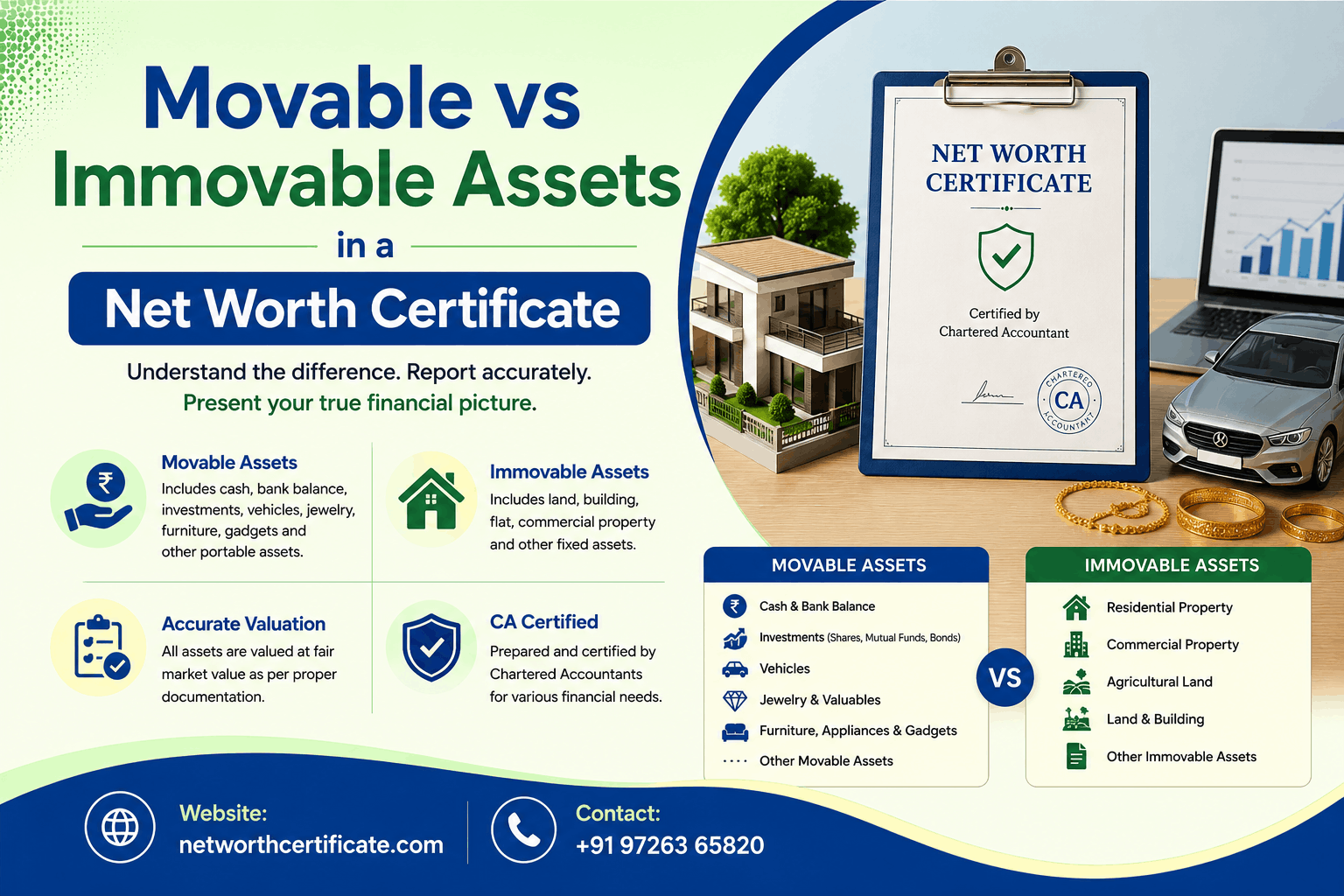
A Net Worth Certificate includes all eligible assets owned by an individual or business to calculate their overall financial position. These assets are divided into movable assets and immovable assets based on their nature. Knowing the difference helps ensure the correct valuation, proper documentation, and smooth verification process. A Chartered Accountant (CA) verifies ownership, determines the fair market value of each eligible asset, and prepares a professionally certified Net Worth Certificate accepted by banks, embassies, financial institutions, universities, and government authorities.
| Criteria | Movable Assets | Immovable Assets |
|---|---|---|
| Meaning | Assets that can be moved from one place to another without changing their value or nature. | Fixed assets that cannot be physically moved from one place to another. |
| Examples | Bank accounts, fixed deposits, cash, gold, jewellery, shares, mutual funds, vehicles, insurance surrender value, business investments. | Residential houses, flats, commercial offices, agricultural land, plots, factories, warehouses, shops, farmhouses, investment properties. |
| Ownership Proof | Bank statements, FD receipts, investment statements, vehicle RC, jewellery invoices, insurance documents. | Sale deed, title deed, property tax receipt, land records, mutation records, possession documents. |
| Valuation Method | Based on current account balance, market value, investment value, or surrender value. | Based on prevailing market value, government guideline value, or valuation by a Registered Valuer. |
| Liquidity | Generally easier to sell or convert into cash. | Usually takes more time to sell or transfer ownership. |
| Depreciation/Appreciation | Some assets (such as vehicles) depreciate, while investments may appreciate. | Property values generally appreciate over the long term, depending on market conditions. |
| Included in Net Worth Certificate | Yes, if ownership is verified and the asset has a measurable value. | Yes, if legal ownership is established and the property is properly valued. |
| Importance | Strengthens liquid financial position and investment portfolio. | Represents long-term wealth and often forms the largest part of total net worth. |
Which Movable and Immovable Assets Can Be Included in a Net Worth Certificate?
Net Worth Certificate includes assets that are legally owned, properly documented, and capable of being accurately valued. Both movable assets and immovable assets contribute to an individual’s or business’s total net worth. However, before including any asset, a chartered accountant (CA) verifies ownership, reviews supporting documents, and determines its current fair market value. The assets included may vary depending on the purpose of the certificate, such as visa and immigration, bank loans, education abroad, business funding, investment, or financial verification.
| Movable Assets | Immovable Assets |
|---|---|
| Savings Bank Account Balance | Residential House |
| Current Bank Account Balance | Apartment or Flat |
| Fixed Deposits (FDs) | Commercial Property |
| Cash in Hand | Agricultural Land |
| Gold & Jewellery | Residential Plot |
| Shares & Stocks | Industrial Property |
| Mutual Funds | Factory Building |
| Bonds & Debentures | Office Space |
| Provident Fund (EPF/PPF) | Warehouse |
| National Savings Certificates (NSC) | Shops & Showrooms |
| Life Insurance Surrender Value | Investment Property |
| Vehicles (Cars, Bikes & Commercial Vehicles) | Farmhouse |
| Business Investments | Commercial Complex |
Assets Usually Accepted in a Net Worth Certificate
A Chartered Accountant generally includes assets that satisfy the following conditions:
- Legally Owned Assets: The asset must legally belong to the applicant, whether individually or jointly. In the case of joint ownership, only the applicant’s ownership share is considered.
- Valid Ownership Proof: Every asset should be supported by appropriate documents such as property deeds, bank statements, investment certificates, vehicle registration certificates, or insurance documents.
- Measurable Market Value: The asset should have a fair market value or realizable value that can be determined using accepted valuation methods.
- No Ownership or Legal Disputes: Assets involved in litigation, ownership conflicts, or legal disputes are generally excluded until the issue is resolved.
- Complete Supporting Documents: Where required, valuation reports, land records, investment statements, or other relevant documents should be available for verification.
Assets That May Require Additional Verification
| Asset Type | Reason for Additional Verification |
| Jointly Owned Property | Owner’s share must be clearly determined. |
| Inherited Property | Succession or inheritance documents may be required. |
| Gifted Property | Gift deed or ownership transfer documents should be available. |
| Agricultural Land | Land records and valuation documents are generally required. |
| Overseas Property | Foreign ownership and valuation documents may be necessary. |
| Foreign Bank Accounts | Overseas bank statements and supporting records are required. |
| Unlisted Company Shares | Independent valuation may be needed. |
| Partnership Interests | Partnership deed and financial statements are generally verified. |
| Business Ownership | Business valuation and ownership proof may be required. |
How Do Liabilities Affect a Net Worth Certificate??
A Net Worth Certificate reflects your actual financial position by considering both your assets and liabilities. While assets represent everything you own, liabilities are the financial obligations or debts you owe. A Chartered Accountant (CA) calculates your net worth by adding the total value of all eligible assets and then deducting the total value of outstanding liabilities. Including liabilities is essential because it provides a true and transparent picture of your financial health. Banks, embassies, financial institutions, universities, and government authorities often review both assets and liabilities before accepting a Net Worth Certificate.
Net Worth Calculation Formula
The standard formula used to calculate net worth is:
Net Worth = Total Assets − Total Liabilities
| Particulars | Amount (₹) |
|---|---|
| Total Assets | 2,50,00,000 |
| Total Liabilities | 50,00,000 |
| Net Worth | 2,00,00,000 |
Common Liabilities Included in a Net Worth Certificate
A Chartered Accountant generally includes the following financial liabilities while preparing a Net Worth Certificate:
- Home Loan – Outstanding balance on a residential property loan.
- Loan Against Property (LAP) – Loans secured against residential or commercial property.
- Vehicle Loan – Outstanding loan amount for cars, bikes, or commercial vehicles.
- Personal Loan – Any unsecured personal loan that is yet to be repaid.
- Business Loan – Loans taken for business operations or expansion.
- Education Loan – Outstanding loan for higher education.
- Credit Card Outstanding – Unpaid credit card dues at the time of preparing the certificate.
- Mortgage Loan – Financial obligations secured against immovable property.
- Overdraft Facility – Outstanding amount utilized under an overdraft account.
- Other Financial Obligations – Any legally payable debt or financial liability supported by relevant documents.
Why Is It Important to Declare Liabilities?
Declaring all eligible liabilities is just as important as declaring your assets. It helps ensure that the Net Worth Certificate accurately represents your financial position and avoids discrepancies during verification. Proper disclosure of liabilities offers several benefits, including:
- Accurate Net Worth Calculation:
Ensures the certificate reflects your actual financial worth after deducting outstanding debts. - Greater Financial Transparency:
Provides a complete and honest overview of your financial position. - Improved Credibility:
Builds confidence among banks, embassies, investors, universities, and government authorities. - Regulatory Compliance:
Helps meet financial reporting and documentation requirements. - Faster Verification Process:
Reduces the chances of objections, queries, or delays during document verification.
Benefits of Correct Asset Classification in a Net Worth Certificate
Ensures accurate valuation of both movable and immovable assets.
Helps the Chartered Accountant apply the correct valuation method for each asset.
Makes the Net Worth Certificate clear, organized, and easy to understand.
Ensures the correct ownership and supporting documents are attached.
Improves acceptance by banks, embassies, financial institutions, and government authorities.
Reduces errors, omissions, and delays during the verification process.
Provides a true and transparent representation of your financial position.
Simplifies financial review and verification by the requesting authority.
Increases the credibility and reliability of the Net Worth Certificate.
Helps ensure compliance with financial reporting and documentation requirements.
Prevents confusion between movable and immovable assets.
Supports a smooth and hassle-free Net Worth Certificate preparation process.
Mandatory Documents Required for Movable and Immovable Assets
To prepare a CA-certified Net Worth Certificate, a Chartered Accountant must verify the ownership and value of every asset included in the certificate. The documents required depend on the type of asset being declared. Submitting complete and updated documents helps ensure accurate valuation and faster preparation of the certificate.
Documents for Movable Assets
- Savings & Current Bank Accounts: Latest bank statement (generally for the last 3–6 months).
- Fixed Deposits (FDs): Fixed Deposit Receipt (FDR) or FD Certificate issued by the bank.
- Cash in Hand: Self-declaration, if applicable.
- Shares & Stocks: Demat account statement or client holding statement.
- Mutual Funds: Consolidated Account Statement (CAS) or mutual fund holding statement.
- Bonds & Debentures: Investment certificate or holding statement.
- Provident Fund (EPF/PPF): Latest EPF or PPF passbook/statement.
- National Savings Certificates (NSC): Original NSC certificate or investment proof.
- Gold & Jewellery: Purchase invoices or a valuation report issued by a registered valuer.
- Life Insurance Policies: Policy document along with the latest surrender value statement.
- Vehicles: Registration Certificate (RC Book) and valid insurance certificate.
- Business Investments: Partnership deed, shareholding certificate, or other business ownership documents.
Documents for Immovable Assets
- Residential House or Flat: Registered sale deed or title deed.
- Commercial Property: Registered sale deed and latest property tax receipt.
- Agricultural Land: Registered sale deed, 7/12 extract, mutation entry, or other applicable land records.
- Residential Plot: Registered sale deed or ownership documents.
- Industrial Property or Factory: Title deed and ownership documents.
- Warehouse, Office Space, Shops & Showrooms: Registered sale deed along with the latest property tax receipt.
- Investment Property or Farmhouse: Registered ownership documents and valuation report, if required.
Providing accurate ownership and valuation documents enables the Chartered Accountant to verify every asset, determine its fair market value, and prepare a reliable Net Worth Certificate that is widely accepted by banks, embassies, financial institutions, universities, and government authorities.
Step-by-Step Process to Include Assets in a Net Worth Certificate
Preparing a Net Worth Certificate is a simple process when you have all the required information and documents. A Chartered Accountant (CA) verifies your assets, checks their current value, and prepares a certified Net Worth Certificate. Follow these simple steps:
- Step 1: Make a List of Your Assets
Start by listing all the movable and immovable assets you own. This may include your bank account balances, fixed deposits, shares, mutual funds, gold, jewellery, vehicles, residential or commercial properties, agricultural land, business investments, and other valuable assets. Also, note down any outstanding loans or liabilities.
- Step 2: Collect the Required Documents
Gather all the documents related to your assets and liabilities. These may include bank statements, investment statements, property documents, vehicle RC, jewellery invoices, land records, valuation reports, and loan statements. Complete documents help avoid delays during verification.
- Step 3: Submit the Documents to a Chartered Accountant
Share all your asset details and supporting documents with a qualified Chartered Accountant (CA). The CA will review the information and confirm that all the required documents are available.
- Step 4: Verification and Asset Valuation
The Chartered Accountant verifies the ownership of each asset and calculates its current market value. If required, additional documents or valuation reports may be requested to ensure the information is accurate.
- Step 5: Calculate Your Net Worth
After verifying all assets, the Chartered Accountant adds the total value of your assets and subtracts your outstanding liabilities to calculate your net worth.
Net Worth = Total Assets − Total Liabilities
This gives a clear picture of your overall financial position.
- Step 6: Receive Your Net Worth Certificate
Once the verification and calculation are complete, the Chartered Accountant prepares and signs your Net Worth Certificate. You can then use the certificate for visa applications, bank loans, education abroad, business funding, financial verification, or other official purposes.
Common Mistakes to Avoid When Including Assets in a Net Worth Certificate
Include only assets that are supported by valid ownership documents.
Submit the latest bank statements, investment statements, and financial records.
Use the current market value instead of estimated or outdated asset values.
Declare all outstanding loans and financial liabilities accurately.
Avoid including assets that are involved in legal or ownership disputes.
Consider only your ownership share in jointly owned assets and properties.
Provide complete property documents, including sale deeds, title deeds, and land records.
Update ownership records before including inherited or gifted properties.
Disclose overseas assets and foreign bank accounts whenever required.
Ensure all information provided is accurate, complete, and consistent across documents.
Keep supporting documents clear, valid, and up to date.
Get your Net Worth Certificate prepared and certified by a qualified Chartered Accountant (CA).
Get Professional Assistance for Your CA-Certified Net Worth Certificate
Preparing a CA-certified Net Worth Certificate requires proper asset classification, accurate valuation, complete documentation, and correct disclosure of liabilities. At NetWorthCertificate.com, our experienced Chartered Accountants help individuals, NRIs, business owners, professionals, and companies prepare accurate and reliable Net Worth Certificates for visa and immigration, bank loans, higher education, business funding, investment, and other official purposes. We ensure that every movable and immovable asset is properly verified and valued in accordance with the requirements of banks, embassies, financial institutions, universities, and government authorities, making the certification process simple, fast, and hassle-free.
🌐 Website: networthcertificate.com
📞 Contact: +91 97263 65820
